
The short answer
You prove it with a record that connects each file to where it came from, who owns it, and the agreement that lets you use it. A purchase receipt or a signed license in a contract folder isn’t enough on its own, because it rarely says which files it covers or what happened to them afterward.
Having a dataset doesn’t mean you own it, have permission to train models on it, or can pass it to another company. Your training data may come from your own systems, data providers, public repositories, research institutions, collection programs, or generative models, and each source can carry different ownership, license terms, and contract obligations. It gets harder when data passes through several companies, is converted into new formats, or is combined with other datasets.
To show your training data is being used the way its terms allow, you need a documented chain from each file to its origin, its legal owner, and the rights under which you can use it. This article covers what to record, when to record it, and how to keep that chain intact as your data moves.
What it means to have the rights to your AI training data
Having the rights to your AI training data means having the legal permissions your intended use requires. Those permissions depend on where the data came from and how you got it:
- Owned data. Your company collected or created the data and holds the relevant rights, subject to any privacy, contract, or third party restrictions.
- Licensed data. Another company owns or controls the data and has granted you specific rights to use it.
- Purchased datasets. You bought a dataset, but the purchase agreement decides whether you received ownership or a limited license.
- Publicly available data. The data is accessible online, but that doesn’t automatically mean you can use it for commercial AI training.
- Openly licensed data. The data carries a license that may allow some uses while requiring attribution or limiting redistribution.
- Synthetic data. A model generated the data, and the model provider’s terms can affect what you’re allowed to do with it.
Permission to access, analyze, or store data doesn’t always include permission to train models on it. One license might allow internal research but prohibit commercial model development. Another might allow training but restrict sharing the original files.
The question isn’t simply who owns the data. It’s whether you have the rights for the specific way you intend to use it.
Why proof of rights matters for AI training data now
For a long time, few people asked where training data came from. Courts, customers, and procurement reviewers are asking now, and recent decisions show that how data was acquired can matter as much as how it was used.
How the copies were acquired. In Bartz v. Anthropic, Judge William Alsup ruled on June 23, 2025, that using books to train large language models was fair use, and so was scanning print books the company had bought. The pirated copies were a different matter. Anthropic had downloaded more than seven million pirated books, and the court found it “lacked any entitlement to hold copies of the books at all,” leaving those copies for trial. The case settled for $1.5 billion, about $3,000 for each of 482,460 works, and the settlement requires Anthropic to destroy the pirated files. The court granted final approval on July 20, 2026. The order notes Anthropic’s statement that the pirated datasets weren’t in the training data of its commercially released models; the liability came from acquiring and keeping them. The same company, the same kind of books, and the same training purpose ended in very different places depending on where the copies came from.
What your vendors copied. In September 2026, the US Court of Appeals for the Third Circuit ruled in Thomson Reuters v. ROSS Intelligence that ROSS’s use of 2,243 Westlaw headnotes to train its legal search tool was not fair use. ROSS didn’t write its training data itself. It hired LegalEase to produce about 25,000 training memos, and LegalEase and its subcontractor, Morae Global, used Westlaw headnotes to write them. On appeal, ROSS didn’t dispute that their actions were attributable to ROSS. The court also found that the market for licensing headnotes as AI training data “is rapidly developing.” ROSS’s tool couldn’t generate new text, and the court set it apart from the generative AI cases, so the ruling doesn’t settle those. It does show that when your training data passes through vendors, what they copied can be attributed to you.
Publicly available doesn’t mean free to use. Longpre et al., “Consent in Crisis” (NeurIPS 2024) audited 14,000 web domains behind three widely used AI training corpora, C4, RefinedWeb, and Dolma, tracking their robots.txt files and terms of service from January 2016 to April 2024. Restrictions on AI crawlers rose sharply in a single year:
| Share of tokens fully restricted by robots.txt | 2023 | April 2024 |
|---|---|---|
| All tokens in C4, RefinedWeb, and Dolma | About 1% | 5 to 7% |
| Tokens from the most critical web domains | Under 3% | 20 to 33% |
| News site tokens among the most critical domains | 3% | Nearly 45% |
Figures from Section 3.1 of the published paper. The first row compares mid 2023 with April 2024, and the critical domain figures (the authors’ HeadAll set) compare April 2024 with one year earlier. “Fully restricted” counts only domains that block a crawler entirely; the authors note the numbers are higher for partial restrictions.
Terms of service go further. The authors found that 45 to 55% of all tokens in the three corpora had some form of data use restriction in their terms pages, and that websites’ robots.txt files and terms often disagree. If a file came from the open web, the fact that you could download it says little about what you’re allowed to do with it. For how often license fields on dataset hosting sites are missing or wrong, see What is data provenance for AI training data?
What to record to prove your AI training data rights
The most practical approach is a structured record for each dataset and, where it matters, each file. MLtwist keeps that record on a Data Card, which captures fields like these:
| Data Card field | What it documents |
|---|---|
| Filename | The name or unique ID of the original file |
| Location | Where the data was captured, when that applies |
| Date | When the data was originally recorded or created |
| Descriptive fields | What the data contains, such as objects, conditions, or time of day |
| Data owner | The company or person holding the relevant legal rights |
| Data source | The company or provider you got the data from |
| Usage rights | What uses are allowed, what’s restricted, and the license terms |
| Data labeler | Who annotated the data, when that applies |
| Data acquisition agreement | The contract or license that governs how you acquired and can use the data |
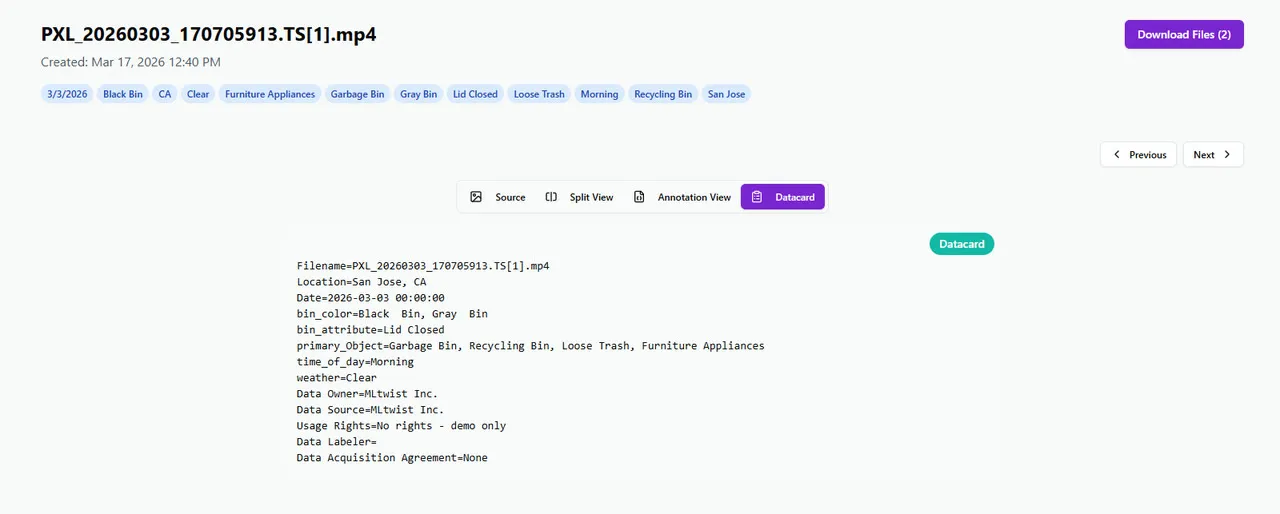
A Data Card in MLtwist for a demo video. Its usage rights field says the file carries no rights beyond the demo, which is exactly the kind of limit that should travel with a file.
Recording both the owner and the source matters more than it looks. Say you buy a collection of images from a data provider. You may have broad usage rights under your contract with the provider, while the images were captured by a different company entirely. With only one of those fields, that distinction disappears.
Linking each file to its acquisition agreement is what lets you answer the questions that come later: can this data be used for commercial training, shared with a contractor, or built into a product?
How MLtwist records rights on the Data Card
When a file enters MLtwist, its source, owner, capture details, and usage terms are recorded, including consent for collected data. For data MLtwist collects, capture location, ownership, associated contracts, and usage rights are on file from the moment the recording is uploaded. The same Data Card records who labeled and reviewed each file and which companies and tools were involved. Synthetic files are recorded as synthetic, with the scenario, scene, and every prompt behind them (more on that below). The platform writes it as the work runs, so no one fills it in by hand or pieces it together after the fact. Learn more about data provenance at MLtwist.
What JAMESON records, and what the Data Card adds
MLtwist also created JAMESON (JSON Annotation Model with Embedded Schema and Ontology Notation), an open JSON format for labeling data across images, video, audio, text, 3D, spreadsheets, and documents. It carries the label side of provenance inside the label file itself. It doesn’t define fields for ownership, usage rights, or agreements; those belong to the Data Card.
| What’s recorded | Where it’s defined |
|---|---|
| Each file’s name, type, stable ID, and storage location | JAMESON |
| Who or what made each label: a person, a model, or a consensus rule, with an author ID, a role such as labeler or reviewer, and a timestamp | JAMESON |
| Every labeler’s, reviewer’s, and model’s answer side by side, with the final answer flagged and the answers it was resolved from | JAMESON |
| The dataset’s contributor, creation date, version, and ontology version | JAMESON |
| Data owner, data source, usage rights, and acquisition agreement | Data Card |
| Capture location and date, consent for collected data, and descriptive fields | Data Card |
| Which companies and tools were involved, and how each met your requirements | Data Card |
| For synthetic files, the scenario, scene, and prompts behind each one | Data Card |
The spec recommends stable, non personal IDs for annotators rather than names or email addresses, since label files often travel beyond the platform that made them. JAMESON is publicly documented under a Creative Commons Attribution license, so you and your developers can read exactly what it records. Explore the open specification: MLtwist JAMESON specification
What a Data Card can and can’t prove
A Data Card is documentation, not legal proof. It gives you an auditable record of the rights you claim and the evidence behind them: who supplied each file, under which agreement, with which restrictions, and who worked on it.
It can’t, on its own, guarantee that a supplier really owned the data, that a license is valid or covers your use, or that the people who labeled it were treated in line with labor law. Those depend on the underlying contracts, the facts, and the law where you operate, and they are questions for your legal team.
What the record does is make every claim specific and checkable. Instead of “we licensed this dataset,” you can point to the agreement behind each file, the restriction that came with it, and the people and companies that handled it. That gives your legal team, an auditor, or a customer something concrete to examine, and it shows you where the gaps are before someone else finds them.
Capture ownership and usage rights when your data arrives
The easiest time to document your rights is when the data first enters your company or your data platform. Once a model has been trained on it, rebuilding that information can be slow, expensive, or impossible.
A simple way to start is a standard spreadsheet template at intake. Say you’re receiving 10,000 images from a supplier. Ask the supplier for a spreadsheet that lists each filename with its capture date, owner, source, usage rights, and the agreement that covers it. Bring that spreadsheet in alongside the images, and match each row to its file.
Now the rights information is part of your data’s metadata instead of an email attachment or a procurement folder. That has real advantages:
- Gaps show up early. Missing ownership or license details surface before the data reaches a training pipeline.
- Restrictions get reviewed first. You can check usage limits before the data is shared or processed.
- Agreements connect to files. Each contract points to the files it governs.
- The record carries forward. Rights information can follow your data as it’s converted or combined.
- Anyone can trace it back. Auditors, customers, and your legal team can follow a dataset to its supporting documents.
The spreadsheet isn’t the long term answer. It’s an easy way to collect consistent information at intake. The value comes from keeping that information attached to your data for as long as you use it.
Rights information from the first step with MLtwist
MLtwist reads directly from your Google Cloud Storage, Amazon S3, or Azure Blob bucket and registers each file as it comes in, so it can be tracked from that point on. Metadata and companion files, including data cards, are attached to each file, and data you bring gets a Data Card from the moment it enters the platform. Learn more about data preparation at MLtwist.
Keep the chain of rights as your data moves between datasets and providers
Training data rarely stays in its original form. An image may be resized, converted, labeled, filtered, and combined with thousands of others. A video may be split into frames. A document may be run through OCR and turned into structured text.
It also moves between companies:
Data collector → data provider → AI developer → labeling provider → model training team
Each company does something different, and each handoff may be governed by a different agreement. As the ROSS case shows, a vendor’s work can come back to you.
Your records should keep the link between the original file and every dataset built from it. If an image ends up in three training datasets, each one should still point back to the original image and its rights. If the original came with a restriction on commercial use, that restriction shouldn’t disappear because the file was renamed, reformatted, or labeled.
Ownership and usage rights should follow your data, even when the data itself changes.
That doesn’t mean every derived dataset carries identical rights. New processing, annotations, or agreements can add rights and obligations. The record should keep the original terms and document what changed since.
Without that chain, you can end up with a large, valuable dataset and no reliable way to show where any one file came from.
What if your data provider keeps its sources confidential?
Data provenance doesn’t require every company in the chain to disclose every commercial relationship. A provider may have bought images from several collection partners under agreements that forbid naming them, and you may still have legitimate rights to use those images without knowing who captured each one.
This is the difference between keeping provenance and disclosing provenance. Your records should support both:
- What you see. The record you receive can name your contracted provider, your usage rights, and the agreement that covers them, without revealing the provider’s own sources.
- What the provider keeps. The provider should keep its own records linking the delivered files to their original sources and the agreements behind them.
- What happens in a dispute. If a rights question, audit, or contract review comes up, there should be a way to trace the data back through the chain, subject to confidentiality obligations and the cooperation of the companies involved. That might mean a confidential record review, an independent audit, or a controlled disclosure rather than open access to every upstream record.
Confidentiality shouldn’t mean giving up traceability. Before you sign, ask your provider how it would answer a rights question about a specific file, even if it can’t tell you its sources today.
Don’t forget the people who labeled your training data
The original files are only part of what you need rights to. Many training datasets also contain annotations made by people: bounding boxes, classifications, text labels, transcriptions, and more. Those annotations may come from employees, contractors, specialists, or distributed workforces, and you should know who made them and under what arrangements.
Depending on your situation, a customer, auditor, or regulator may ask for evidence about:
- Annotation ownership. Whether the company delivering the labeled dataset has the rights to the annotations it’s handing you.
- Contract relationships. Which company employed or contracted the labelers, and which agreements governed the work.
- Worker compensation and conditions. Whether labelers were paid and worked in line with the laws and contract terms that apply.
- Annotation provenance. Whether each label was made by a person, generated by a model, or both.
These requirements vary by country, worker classification, contract, and use, and not every dataset needs the same evidence. But if your labeling runs through third party providers, especially through subcontractors or widely distributed teams, it’s worth knowing how you’d answer if asked. MLtwist’s Data Card shows who labeled and reviewed each file, which companies and tools were involved, and how each met your security and ethical requirements. That’s a record of what was required and reported, not a certification of labor law compliance.
For more on the labeling side, see How do I know my AI training data was labeled by real people?, and for why the people behind your data belong in its provenance record, What is data provenance for AI training data?
If your training data is synthetic, record how it was made
Synthetic data is generated rather than recorded, so there’s no camera operator or collection contract behind it. It still has a history, and the rights questions don’t go away. For each synthetic file, record:
- That it’s synthetic. So real and generated data can share a training set without anyone losing track of which is which.
- The model used. Which model and version generated the file, so you know whose terms applied.
- The prompts and model responses, where relevant. The scenario, the prompts that produced the file, and what the model returned along the way.
The model matters because provider terms follow the output. Google’s Gemini API Additional Terms of Service, for example, say Google won’t claim ownership of the content you generate, but they bar using the service to develop models that compete with it and require you to follow Google’s Generative AI Prohibited Use Policy. If you don’t know which model made a file, you can’t check which terms applied to it.
The prompts matter because of usage policies. Keeping prompts isn’t required for every dataset, but at MLtwist we find it important. Model providers restrict what their models can be used to create. Google’s Generative AI Prohibited Use Policy, for instance, covers categories such as dangerous activities, violence, and misinformation, and says Google may make exceptions for educational, documentary, scientific, or artistic considerations. Training data often needs exactly those edge cases: a hazard detection model needs examples of hazards, and a moderation model needs examples of what it should catch. If anyone questions a generated file, the prompt is the clearest evidence of what you asked for and why: that you were building a dataset to detect a problem, not producing the content the policy is meant to stop.
Some tools are starting to make this easier. We generated this article’s cover image in ChatGPT, and when we went to share it, the share dialog offered to share the image together with the prompt that produced it, along with a public link to that prompt.
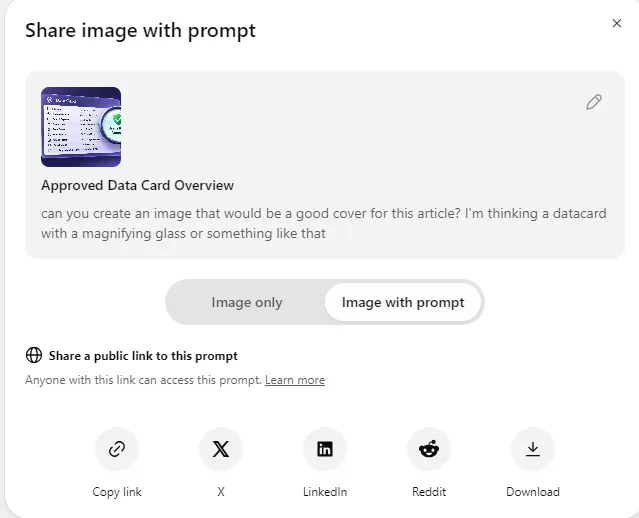
The share dialog in ChatGPT for this article’s cover. Sharing the image with its prompt keeps the record of how it was made attached to it.
On MLtwist, the Data Card on each synthetic file records the scenario and spreadsheet row it came from, its scene, and every prompt, including each clip’s prompt.
A checklist: can you prove you have the rights to your AI training data?
Before you train on a dataset, ask:
- Origin. Do you know where the data came from and when it was collected?
- Owner. Do you know who owns or controls the relevant rights?
- Source. Can you name the provider you got it from?
- Agreement. Do you have the contract or license that governs your use?
- Intended use. Does that agreement allow the training you plan to do?
- Restrictions. Do you know of any limits on redistribution, commercial use, or sharing?
- Derived data. Can you trace converted or combined datasets back to their original files?
- Labels. If the data was labeled, do you know who did it and what rights apply to the annotations?
- Synthetic data. If any of it was generated, do you know which model made it, and do you have the prompts where they matter?
- Labeling workforce. Could you get evidence about the labeling workforce if someone asked?
- Documentation. Could you produce all of this for a customer review, an audit, or a rights dispute?
If you can’t answer these, you may have gaps in your rights documentation to close before you rely on that data.
Build proof of rights into your data pipeline
Proving you have the rights to your AI training data isn’t a matter of keeping a contract somewhere in the company. It means connecting each file to its origin, ownership, license terms, acquisition agreement, and processing history, and keeping that connection as your data moves through systems, providers, and datasets.
The best time to establish proof of your rights is before the data enters your training pipeline, not after someone asks you to prove them.
MLtwist prepares and labels your data with our team, yours, or both, and delivers it in your format with a Data Card on every file that records where it came from, under what terms, and who touched it. Learn more about data provenance at MLtwist, or get in touch about documenting the rights to your own data.
This article is general information, not legal advice; talk to your counsel about the rights that apply to your data. Court rulings, settlement terms, research findings, and model provider terms are as published in the documents linked above.